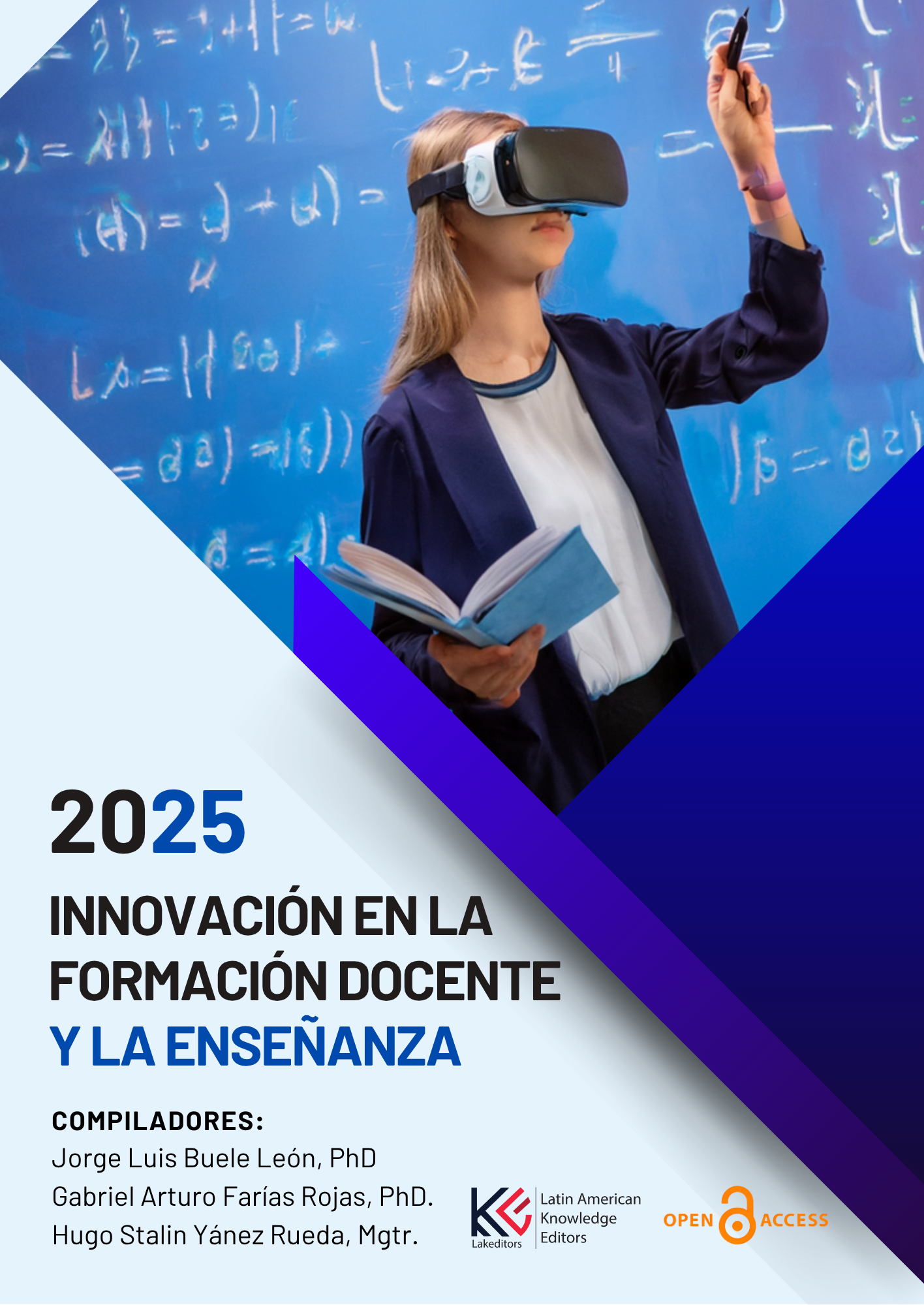
Innovación en la formación docente y la enseñanza
Palabras clave:
Formación docente, Innovación educativa, Tecnologías emergentes, Prácticas pedagógicas, Evaluación educativa, Enseñanza en la educación superiorSinopsis
Este libro es el resultado de un proceso colectivo que se gestó a partir de la necesidad de repensar la formación docente y las prácticas de enseñanza desde la perspectiva de la innovación educativa. Surge como una oportunidad para visibilizar los esfuerzos que, en distintos países, están transformando la docencia y la gestión del aprendizaje.
La idea inicial fue construir un volumen que integrara reflexiones teóricas, experiencias de aula, proyectos de investigación y prácticas pedagógicas concretas desarrolladas en contextos diversos. Cada contribución fue seleccionada por su capacidad de ofrecer soluciones pertinentes, aplicables y éticamente comprometidas con los desafíos actuales de la educación latinoamericana. El proceso de elaboración se desarrolló bajo un sistema de revisión por pares ciegos, garantizando la calidad científica y la coherencia de los contenidos.
En esta obra confluyen autores de diferentes trayectorias y disciplinas, unidos por un propósito común: fortalecer la profesionalización docente y promover un aprendizaje centrado en la persona. La pluralidad de enfoques, metodologías y escenarios representados demuestra que la innovación educativa no responde a una fórmula única, sino a la creatividad y al compromiso de los educadores frente a realidades cambiantes. Esta diversidad constituye una de las mayores riquezas del libro.
Como compiladores, concebimos este proyecto no solo como un producto académico, sino como un espacio de encuentro y colaboración. Cada capítulo aporta una mirada singular, pero al mismo tiempo se enlaza con los demás en torno a un objetivo compartido: construir una educación más equitativa, abierta a la tecnología y sensible a las necesidades humanas. La obra busca inspirar a docentes, investigadores y gestores a replantear sus prácticas desde la reflexión crítica y la acción transformadora.
Agradecemos a todas las instituciones y personas que apoyaron esta publicación, en especial a quienes contribuyeron con sus revisiones y sugerencias. Su dedicación permitió consolidar un trabajo que refleja tanto el rigor académico como la pasión por la enseñanza.
Esperamos que estas páginas sirvan como punto de partida para nuevas investigaciones, redes de colaboración y experiencias que fortalezcan la formación docente en nuestra región. La innovación, entendida como búsqueda constante de sentido y mejora, solo se sostiene cuando se comparte y se transforma en práctica.
Capítulos
-
Estrategias de aprendizaje activo: Aprendizaje Basado en Proyectos (ABP), Aprendizaje Cooperativo / Colaborativo y Aula Invertida (Flipped Classroom)
Ceferina Cabrera-Félix

Instituto Superior de Formación Docente Salomé Ureña, ISFODOSUWanda Román-Santana
Instituto Superior de Formación Docente Salomé Ureña, ISFODOSU -
Estrategias tecnológicas como apoyo a los problemas de aprendizaje en estudiantes de educación básica
Lidya Alulima-Alulima
Facultad de Ciencias de la Educación, Universidad Tecnológica IndoaméricaKeyla Armijo-Guillin
Facultad de Ciencias de la Educación, Universidad Tecnológica Indoamérica -
Impacto del desarrollo evolutivo motor en el proceso de aprendizaje
Lizeth Barrionuevo-Ávila
Facultad de Ciencias de la Educación, Universidad Tecnológica IndoaméricaSalome Ayala-Jaramillo
Facultad de Ciencias de la Educación, Universidad Tecnológica Indoamérica -
Creatividad y reflexión desde una perspectiva docente en los matices del diseño curricular aplicado al aula terciaria
Gabriel Farías-Rojas
Escuela de Investigaciones PolicialesMiriam Cid-Uribe
Universidad de Santiago de Chile (USACH)Alejandro Arros-Aravena
Universidad del Bío-Bío (UBB, Chile)Bárbara Cienfuegos-Illanes
SLEP Los Libertadores -
Frankenstein en el contexto de la literatura gótica de horror: una propuesta pedagógica a la enseñanza de la novela
Gabriel Farías-Rojas
Escuela de Investigaciones PolicialesJorge Rueda-Castro
Universidad de Santiago de Chile (USACH)Alejandro Arros-Aravena
Universidad del Bío-Bío (UBB, Chile)Miriam Cid-Uribe
Universidad de Santiago de Chile (USACH) -
Herramientas de inteligencia artificial para el e-learning
Alba Miranda-Villacís
Universidad Tecnológica Indoamérica, Ecuador.Eulalia Becerra-García
Universidad Tecnológica Indoamérica, Ecuador. -
Aulas hospitalarias y tecnología educativa: Identificación y análisis de proyectos implementados
Karla Romero-Coronel
Universidad Tecnológica Indoamérica, Ecuador.Ivonne Andino-Sosa
Universidad Tecnológica Indoamérica, Ecuador.Kevin Aguilar-Aguilar
Universidad Tecnológica Indoamérica, Ecuador. -
El Papel de la Tecnología en la Mejora de la Equidad y Accesibilidad Educativa: Lecciones desde Asia hacia América Latina
Andrés Alcívar
Instituto Oceanográfico de la Armada del Ecuador, Guayaquil, Ecuador -
Innovación tecnológica con enfoque STEM femenino y su impacto en la economía productiva peruana
Sheila Sierralta-Pinedo
RENACYT – Perú, Campus Virtual - Universidad Tecnológica del PerúChristian Corrales-Otazú
Campus Virtual - Universidad Tecnológica del PerúSarita Apaza-Miranda
Universidad Tecnológica del PerúWilliam Gordillo-Gonzales
Universidad Tecnológica del Perú -
Aplicabilidad de la Educación 4.0 y Experiencias de Aprendizaje Innovadoras
Corina Núñez-Hernández
Universidad Técnica de Ambato
Descargas
Los datos de descarga aún no están disponibles.
Referencias
Almulla, M. A. (2019). The Efficacy of Employing Problem-Based Learning (PBL) Approach as a Method of Facilitating Students’ Achievement. IEEE Access, 7, 146480-146494. https://doi.org/10.1109/ACCESS.2019.2945811
Almulla, M. A. (2020). The Effectiveness of the Project-Based Learning (PBL) Approach as a Way to Engage Students in Learning. SAGE Open, 10(3), 2158244020938702. https://doi.org/10.1177/2158244020938702
AlSideiri, A., Tawafak, R. M., Malik, S. I., Alfarsi, G., Khudayer, B. H., & Mathew, R. (2023). Examining the Impact of Software Engineering Problem-Based Learning on Student Performance. 2023 24th International Arab Conference on Information Technology (ACIT), 1-6. https://doi.org/10.1109/ACIT58888.2023.10453857
Baluarte-Araya, C. (2020). Proposal of an Assessment System based on Indicators to Problem Based Learning. 2020 39th International Conference of the Chilean Computer Science Society (SCCC), 1-7. https://doi.org/10.1109/SCCC51225.2020.9281203
Baluarte-Araya, C., & Bedregal-Alpaca, N. (2022). Influence of Problem Based Learning on the development of technical, methodological, participatory and personal competencies: Valuation by Engineering students. 2022 IEEE World Engineering Education Conference (EDUNINE), 1-6. https://doi.org/10.1109/EDUNINE53672.2022.9782362
Basilotta Gómez-Pablos, V., Martín del Pozo, M., & García-Valcárcel Muñoz-Repiso, A. (2017). Project-based learning (PBL) through the incorporation of digital technologies: An evaluation based on the experience of serving teachers. Computers in Human Behavior, 68, 501-512. https://doi.org/10.1016/j.chb.2016.11.056
Bates, G., Le Gouais, A., Barnfield, A., Callway, R., Hasan, M. N., Koksal, C., Kwon, H. R., Montel, L., Peake-Jones, S., White, J., Bondy, K., & Ayres, S. (2023). Balancing Autonomy and Collaboration in Large-Scale and Disciplinary Diverse Teams for Successful Qualitative Research. International Journal of Qualitative Methods, 22, 16094069221144594. https://doi.org/10.1177/16094069221144594
Boelt, A. M., Kolmos, A., & Holgaard, J. E. (2022). Literature review of students’ perceptions of generic competence development in problem-based learning in engineering education. European Journal of Engineering Education, 47(6), 1399-1420. https://doi.org/10.1080/03043797.2022.2074819
Bredow, C. A., Roehling, P. V., Knorp, A. J., & Sweet, A. M. (2021). To Flip or Not to Flip? A Meta-Analysis of the Efficacy of Flipped Learning in Higher Education. Review of Educational Research, 91(6), 878-918. https://doi.org/10.3102/00346543211019122
Campozano Alcivar, J. E., Garcia Santana, P. J., Alava Coello, L. J., Arana Ruiz, M. E., & Inte Saquinga, J. E. (2024, abril 12). Aprendizaje activo y enseñanza efectiva – Biblioteca Ciencia Latina. https://biblioteca.ciencialatina.org/aprendizaje-activo-y-ensenanza-efectiva/
Campozano, J., García, P., Álava, L., Arana, M., & Inte, J. (2024). Aprendizaje activo y enseñanza efectiva (1°). CID - Centro de Investigación y Desarrollo. https://doi.org/10.37811/cli_w1043
Chang, Y.-H., Yan, Y.-C., & Lu, Y.-T. (2022). Effects of Combining Different Collaborative Learning Strategies with Problem-Based Learning in a Flipped Classroom on Program Language Learning. Sustainability, 14(9), 5282. https://doi.org/10.3390/su14095282
Chen, L., Chen, T. L., Fang, C., & Zhou, L. (2019). Book Review: Best Practices for Flipping the College Classroom. The International Review of Research in Open and Distributed Learning, 20(3). https://doi.org/10.19173/irrodl.v20i3.3242
Crespí, P., García-Ramos, J. M., & Queiruga-Dios, M. (2022). Project-Based Learning (PBL) and Its Impact on the Development of Interpersonal Competences in Higher Education. Journal of New Approaches in Educational Research, 11(2), 259-276. https://doi.org/10.7821/naer.2022.7.993
DeLozier, S. J., & Rhodes, M. G. (2017). Flipped Classrooms: A Review of Key Ideas and Recommendations for Practice. Educational Psychology Review, 29(1), 141-151. https://doi.org/10.1007/s10648-015-9356-9
Fernández-Ferrer, M., & Pizarro, D. E. (2022). A flipped classroom experience in the context of a pandemic: Cooperative learning as a strategy for meaningful student learning. Journal of Technology and Science Education, 12(3), 644-658. https://doi.org/10.3926/jotse.1701
Ferrero, M., Vadillo, M. A., & León, S. P. (2021). Is project-based learning effective among kindergarten and elementary students? A systematic review. PLOS ONE, 16(4), e0249627. https://doi.org/10.1371/journal.pone.0249627
Flores, M. A., Veiga Simão, A. M., Barros, A., & Pereira, D. (2015). Perceptions of effectiveness, fairness and feedback of assessment methods: A study in higher education. Studies in Higher Education, 40(9), 1523-1534. https://doi.org/10.1080/03075079.2014.881348
Guo, P., Saab, N., Post, L. S., & Admiraal, W. (2020). A review of project-based learning in higher education: Student outcomes and measures. International Journal of Educational Research, 102, 101586. https://doi.org/10.1016/j.ijer.2020.101586
Hamdan, N., & Mcknight, P. (2013, agosto 9). Review of Flipped Learning. ResearchGate. https://doi.org/10.4236/ce
Heil, J., & Ifenthaler, D. (2023). Online Assessment in Higher Education: A Systematic Review. Online Learning, 27(1). https://doi.org/10.24059/olj.v27i1.3398
Heiss, E. M., & Oxley, S. P. (2021). Implementing a flipped classroom approach in remote instruction. Analytical and Bioanalytical Chemistry, 413(5), 1245-1250. https://doi.org/10.1007/s00216-020-03147-w
Johnson, D. W., Johnson, R. T., & Smith, K. A. (2014). Cooperative Learning: Improving university instruction by basing practice on validated theory. ResearchGate. https://www.researchgate.net/publication/284471328_Cooperative_Learning_Improving_university_instruction_by_basing_practice_on_validated_theory
Kokotsaki, D., Menzies, V., & Wiggins, A. (2016). Project-based learning: A review of the literature. Improving Schools, 19(3), 267-277. https://doi.org/10.1177/1365480216659733
Liu, O. L. (2011). Value-added assessment in higher education: A comparison of two methods. Higher Education, 61(4), 445-461. https://doi.org/10.1007/s10734-010-9340-8
Long, T., Cummins, J., & Waugh, M. (2017). Use of the flipped classroom instructional model in higher education: Instructors’ perspectives. Journal of Computing in Higher Education, 29(2), 179-200. https://doi.org/10.1007/s12528-016-9119-8
Montenegro-Rueda, M., Luque-de la Rosa, A., Sarasola Sánchez-Serrano, J. L., & Fernández-Cerero, J. (2021). Assessment in Higher Education during the COVID-19 Pandemic: A Systematic Review. Sustainability, 13(19), 10509. https://doi.org/10.3390/su131910509
Morgado Bernal, I. (2022). El examen oral como promotor del aprendizaje activo. Revista Científica Estudios e Investigaciones, 11(1), 130-134. https://dialnet.unirioja.es/servlet/articulo?codigo=9296643
O’Flaherty, J., & Phillips, C. (2015). The use of flipped classrooms in higher education: A scoping review. The Internet and Higher Education, 25, 85-95. https://doi.org/10.1016/j.iheduc.2015.02.002
Oliván-Blázquez, B., Aguilar-Latorre, A., Gascón-Santos, S., Gómez-Poyato, M. J., Valero-Errazu, D., Magallón-Botaya, R., Heah, R., & Porroche-Escudero, A. (2023). Comparing the use of flipped classroom in combination with problem-based learning or with case-based learning for improving academic performance and satisfaction. Active Learning in Higher Education, 24(3), 373-388. https://doi.org/10.1177/14697874221081550
Parmigiani, D., Nicchia, E., Murgia, E., & Ingersoll, M. (2024). Formative assessment in higher education: An exploratory study within programs for professionals in education. Frontiers in Education, 9. https://doi.org/10.3389/feduc.2024.1366215
Rahmayani, S., & Yogica, R. (2021). LITERATURE STUDY THE EFFECT OF VARIATIONS OF THE APPLICATION OF THE PROBLEM BASED LEARNING (PBL) MODEL ON STUDENTS ’LEARNING INTEREST IN MIDDLE SCHOOLS. Universe, 2(2), 185-191. https://doi.org/10.24036/universe.v2i2.86
Riegel, K. A. (2023). Project based learning (PBL): Less project, more problem. The Journal of the Acoustical Society of America, 153(3_supplement), A272. https://doi.org/10.1121/10.0018820
Sanchez-Romero, J. L., Jimeno-Morenilla, A., Pertegal-Felices, M. L., & Mora-Mora, H. (2019). Design and Application of Project-Based Learning Methodologies for Small Groups Within Computer Fundamentals Subjects. IEEE Access, 7, 12456-12466. https://doi.org/10.1109/ACCESS.2019.2893972
Touzard, L. I. M., Noriega, M. A. C., & Rugel, L. H. B. (2023). Developing 21st-century skills through PBL in a public university. PODIUM, 43, 111-128. https://doi.org/10.31095/podium.2023.43.07
Warnock, J. N., & Mohammadi-Aragh, M. J. (2016). Case study: Use of problem-based learning to develop students’ technical and professional skills. European Journal of Engineering Education, 41(2), 142-153. https://doi.org/10.1080/03043797.2015.1040739
Віштак, І. (2023). Методика використання проблемного навчання на лекційних заняттях з теоретичної механіки. Педагогіка безпеки, 8(1-2), 37-43. https://doi.org/10.31649/2524-1079-2023-8-1-037-043
Alvarez Matute, J. F., Garcia Herrera, D. G., Erazo Álvarez, C. A., & Erazo Álvarez, J. C. (2020, 7). GeoGebra como estrategia de enseñanza de la Matemática. Revista Electrónica de Ciencias de la Educación, Humanidades, Artes y Bellas Artes, 3(6). https://fundacionkoinonia.com.ve/ojs/index.php/epistemekoinonia/article/view/827
Calle, Z. D., Aliaga, V. M. N., & Molina, M. A. B. (2024). Comprensión lectora en la era digital: Una revisión sistemática. Revista Andina de Educación, 7(2). https://www.redalyc.org/journal/7300/730077730001/html/
Castillo, E. M., & Tubay, M. E. (2021). B-learning como estrategia para mejorar el aprendizaje de un idioma extranjero en estudiantes de Educación Básica de la Unidad Educativa Jean Piaget. Revista Cognosis. ISSN 2588-0578, 6(3), 97-106. https://doi.org/10.33936/cognosis.v6i2.2857
CEPAL. (2016, 10). La matriz de la desigualdad social en América Latina | Comisión Económica para América Latina y el Caribe. https://www.cepal.org/es/publicaciones/40668-la-matriz-la-desigualdad-social-america-latina
de la Caridad Maqueira Caraballo, G., Guerra Iglesias, S., Martínez Isaac, R., & Velastegui López, L. E. (2023). La educación inclusiva: Desafíos y oportunidades para las instituciones escolares. Journal of Science and Research: Revista Ciencia e Investigación, 8(3), 210-228. https://dialnet.unirioja.es/servlet/articulo?codigo=9048728
Escofet Soteras, C., Fernández Fernández, M. A., Torrents Fenoy, C., del Valle, F. M., Ros Cervera, G., & Machado Casas, I. S. (2022). Trastorno por déficit de atención e hiperactividad (TDAH). 1-8. https://www.aeped.es/sites/default/files/documentos/09.pdf
Esquivel, J. A. F. (2025). Las líneas de tiempo como herramienta pedagógica orientada a mejorar el aprendizaje de la Historia. Un estudio de caso en la escuela “Benemérita Escuela Secundaria N.o 1 Profr. Froylán Parroquín García”. Dilemas contemporáneos: Educación, Política y Valores. https://doi.org/10.46377/dilemas.v12i2.4522
García, M., Cruz, J. D. de la, & Rodríguez, O. C. (2021). Estrategia para la integración de las Tecnologías de la Información y las Comunicaciones en la formación inicial de docentes. EduSol, 21(75), 96-103. https://www.redalyc.org/journal/4757/475768571008/html/
Guadamud Muñoz, J. D., Chiriboga Palacios, I. A., Zumba Juela, J. M., Briceño Salazar, R., Jiménez Vargas, J. J., & Palma Candelario, Á. L. (2024, mayo 17). Innovaciones y tendencias en los sistemas de evaluación educativa. V(3).
Guerrero-Vaca, D. J., Naranjo-Herrera, J. C., Rodríguez-Cevallos, M. de los Á., & Benítez, I. (2022, abril 4). Comunicación y herramientas digitales para la dislexia ¿Un problema en la Educación? Una revisión. Pol. Con. (Edición núm. 69), 7.
Guevara Albán, G. P., Ronquillo Murrieta, G. V., Luna Rivera, E. D., & Acosta Caicedo, F. J. (2023). Análisis de las Estrategias Tecnológicas Aplicadas a la Educación Inicial. Journal of Science and Research: Revista Ciencia e Investigación, 8(Extra 2), 355-364. https://dialnet.unirioja.es/servlet/articulo?codigo=9235499
Jaramillo Hurtado, J. L., & Escudero Benavides, P. M. (2023, enero 12). El impacto de las tic en el ciclo de aprendizaje. 9(1), 93-116.
López López, M. M., Sánchez, P. K., Mero Chávez, E. J., & Rodríguez Gámez, M. (2019, agosto 13). Estrategias tecnológicas como fortalecimiento en el aprendizaje crítico. https://www.eumed.net/rev/atlante/2019/08/estrategias-tecnologicas-aprendizaje.html
Mamani, M. R. (2019). Capacitación en diagnóstico e intervención psicopedagógica de la dislalia funcional. Horizontes. Revista de Investigación en Ciencias de la Educación, 3(10), 122-133. https://doi.org/10.33996/revistahorizontes.v3i10.73
Mateo Ramírez, J. L., Lucín Lindao, L. M., Del Pezo Reyes, S. M., & Perero Borbor, B. E. (2025, abril 28). Formación Docente para la Educación Inclusiva en Instituciones Públicas del Ecuador: Retos y Estrategias. Reincisol, 4(7). https://dialnet.unirioja.es/descarga/articulo/10355125.pdf
Mejía Tigre, N. I., García Herrera, D. G., Erazo Álvarez, J. C., & Narváez Zurita, I. (2020). Genially como estrategia para mejorar la comprensión lectora en educación básica. CIENCIAMATRIA, 6(Extra 3), 520-542. https://dialnet.unirioja.es/servlet/articulo?codigo=8318357
Noëlle, F. M. (2023, febrero 24). Kahoot y Quizizz: Cuando jugar en equipos marca la diferencia a la hora de motivar a leer noticias de ciencias. Facultat d’Educació Universitat de Barcelona. Passeig de la Vall d’Hebron 171. https://dialnet.unirioja.es/descarga/articulo/8887990.pdf
Núñez Pérez, J. C. (2020). Predicción del rendimiento académico del alumnado de Bachillerato: Efecto de los enfoques de aprendizaje y atribuciones causales. Revista de Psicología y Educación / Journal of Psychology and, 108-236. https://www.revistadepsicologiayeducacion.es/pdf/20201502.pdf
Pacheco, A. D. C., Chiriap, M. M. C., & Tacuri-Reino, D. (2023). Comprensión lectora en estudiantes de educación básica superior: Estudio de caso de una unidad educativa del cantón Cuenca. Revista PSIDIAL: Psicología y Diálogo de Saberes. ISSN: 2806-5972, 2(2), 48-66. https://doi.org/10.33936/psidial.v2i2.6092
Prensky, M. (2024). Nativos e Inmigrantes Digitales (Distribuidora SEK, S.A.). https://www.marcprensky.com/writing/Prensky-NATIVOS%20E%20INMIGRANTES%20DIGITALES%20(SEK).pdf
Quinzo, J. I., Orellana, A. R. L., Farias, A. D. Z., Quinaucho, R. E. Z., & Soto, C. P. Z. (2024). Diseño Universal de Aprendizaje (DUA): Estrategias para la inclusión educativa. Ciencia Latina Revista Científica Multidisciplinar, 8(4), 10216-10240. https://doi.org/10.37811/cl_rcm.v8i4.13166
Quiroz Peña, J. I., Rizo Vélez, J. R., De La Torre Lascano, C. M., Rizo Vélez, G. D., Quiroz Peña, J. I., Rizo Vélez, J. R., De La Torre Lascano, C. M., & Rizo Vélez, G. D. (2022). Impacto de la gamificación en el aprendizaje de estudiantes universitarios ecuatorianos. Estudio de caso. Revista Estudios del Desarrollo Social: Cuba y América Latina, 10(3). http://scielo.sld.cu/scielo.php?script=sci_abstract&pid=S2308-01322022000300006&lng=es&nrm=iso&tlng=es
Rojas, O., Díaz, J., Veloz, C., Espinoza, D., Merino, A., & Granda, M. (2024). Las dificultades de aprendizaje: Una mirada real desde el contexto educativo. Universidad Tecnológica Indoamérica. https://hdl.handle.net/20.500.14809/6885
Roldán, P. N. (2017, agosto 21). Tecnología: Qué es, usos y ejemplos. Economipedia. https://economipedia.com/definiciones/tecnologia.html
Santillán, C. M. T., Párraga, A. P. B., Santillan, R. Y. G., Quiña, M. de los A. G., & Alvare, M. A. C. (2024a). Formación Docente en el Uso de Herramientas Tecnológicas para el Apo-yo a las Necesidades Educativas Especiales en el Aula. Ciencia Latina Revista Científica Multidisciplinar, 8(3), 3768-3797. https://doi.org/10.37811/cl_rcm.v8i3.11588
Santillán, C. M. T., Párraga, A. P. B., Santillan, R. Y. G., Quiña, M. de los A. G., & Alvare, M. A. C. (2024b). Formación Docente en el Uso de Herramientas Tecnológicas para el Apo-yo a las Necesidades Educativas Especiales en el Aula. Ciencia Latina Revista Científica Multidisciplinar, 8(3), 3768-3797. https://doi.org/10.37811/cl_rcm.v8i3.11588
Torres Flórez, D., Rincón Ramírez, A. V., & Rocío Medina Moreno, L. (2022). Competencias digitales de los docentes en la Universidad de los Llanos, Colombia. Trilogía: Ciencia Tecnología Sociedad, 14(26 (Enero-Abril)). https://dialnet.unirioja.es/servlet/articulo?codigo=8388898
UNESCO. (2023). Tecnologia en la educacion. https://www.unesco.org/gem-report/sites/default/files/medias/fichiers/2023/07/7952%20UNESCO%20GEM%202023%20Summary_ES_Web.pdf
Vargas-Murillo, G. (2020). Estrategias educativas y tecnología digital en el proceso enseñanza aprendizaje. Cuadernos Hospital de Clínicas, 61(1), 114-129. http://www.scielo.org.bo/scielo.php?script=sci_abstract&pid=S1652-67762020000100010&lng=es&nrm=iso&tlng=es
Ajuriaguerra, J. (1990). Manual de psiquiatría infantil. Masson (4.a ed.). https://espaciopsicopatologico.wordpress.com/wp-content/uploads/2017/02/manual_de_psiquiatria_infantil_ajuriaguerra.pdf
Alva, M. del P. M., Kahn, I. C., Huerta, P. M., Sánchez, J. L., Calixto, J. M., & Sánchez, S. M. V. (2015). Neurodesarrollo infantil: Características normales y signos de alarma en el niño menor de cinco años. Revista Peruana de Medicina Experimental y Salud Pública, 565-573. https://doi.org/10.17843/rpmesp.2015.323.1693
ANDO, F., TERASHIMA, T., TAKAHASHI, H., KURITA, H., TAKAYAMA, A., & ENDO, Y. (2023). Trunk Muscle Thickness During Supine and Crawling Exercises. International Journal of Exercise Science, 16(4), 1103-1112. https://doi.org/10.70252/LPSS3401
Ayres, A. J., & Robbins, J. (2005). Sensory Integration and the Child: Understanding Hidden Sensory Challenges. Western Psychological Services.
Berk, L. E. (2018). Development Through the Lifespan. Pearson.
Carboni-Román, A., Río, D. del, Capilla, A., Maestú, F., & Ortiz, T. (Invalid date). The neurobiological foundations of learning disabilities. Revista de Neurología, 42(Suplemento 2), 171-175. https://doi.org/10.33588/rn.42S02.2005832
Cárdenas, G., Gálvez, F., Ruano, K., & Lagos, D. G. (2017). Efectos del uso del caminador en el desarrollo de los bebés. Boletín Informativo CEI, 4(1), 73-76.
Coarasa, L. M. (2016, noviembre 8). El gateo y su importancia para el neurodesarrollo | Capacita-le. Centro de Neurodesarrollo y Aprendizaje. http://capacita-le.es/el-gateo-y-su-importancia-para-el-neurodesarrollo/
Heinsen, M. (2018). Autoestima y tacto pedagógico en edad temprana: Orientaciones para educadores y familias. Narcea Ediciones.
Papalia, D. E. (2012). Desarrollo humano. McGRAW-HILL/INTERAMERICANA EDITORES, S.A. DE C.V., 736.
Pérez Porto, J., & Gardey, A. (2023, 5). Aprendizaje—Definicion.de. Definición.de. https://definicion.de/aprendizaje/
Pérez-García, P., Martínez-Gómez, N., Górgolas, S. V., Chamorro-Francisco, A., Pardillo-Díaz, R., Nunez-Abades, P., Castro, C., & Carrascal, L. (2025). ErbB signaling in brain injury regeneration: Pathway interactions and therapeutic potential. Neural Regeneration Research, 10.4103/NRR.NRR. https://doi.org/10.4103/NRR.NRR-D-25-00155
Piek, J. P., Dawson, L., Smith, L. M., & Gasson, N. (2008). The role of early fine and gross motor development on later motor and cognitive ability. Human Movement Science, 27(5), 668-681. https://doi.org/10.1016/j.humov.2007.11.002
Salls, J. S., Silverman, L. N., & Gatty, C. M. (2002). The relationship of infant sleep and play positioning to motor milestone achievement. The American Journal of Occupational Therapy: Official Publication of the American Occupational Therapy Association, 56(5), 577-580. https://doi.org/10.5014/ajot.56.5.577
Serrano, L. S., Talayero, J. M. P., Pérez, A. S., Burucúa, M. G., Ruano, J. M., Muncharaz, M. J. B., Estellés, T. L., & Soto, B. B. (1996). Patrones de uso, creencias populares y accidentabilidad por andador infantil (tacatá). Bases para una campaña de información sanitaria. 44.
Stephenson-Jones, M., Yu, K., Ahrens, S., Tucciarone, J. M., van Huijstee, A. N., Mejia, L. A., Penzo, M. A., Tai, L.-H., Wilbrecht, L., & Li, B. (2016). A basal ganglia circuit for evaluating action outcomes. Nature, 539(7628), 289-293. https://doi.org/10.1038/nature19845
Zhang, P., Duan, L., Ou, Y., Ling, Q., Cao, L., Qian, H., Zhang, J., Wang, J., & Yuan, X. (2023). The cerebellum and cognitive neural networks. Frontiers in Human Neuroscience, 17. https://doi.org/10.3389/fnhum.2023.1197459
Ballester, J., & Ibarra, N. (2016). La educación lectora, literaria y el libro en la era digital. Revista chilena de literatura, 94, 147-171. https://doi.org/10.4067/S0718-22952016000300008
Calle, Z. D., Aliaga, V. M. N., & Molina, M. A. B. (2024). Comprensión lectora en la era digital: Una revisión sistemática. Revista Andina de Educación, 7(2), 000721-000721. https://doi.org/10.32719/26312816.2024.7.2.1
Carroll, N. (1987). The Nature of Horror—Noel Carrol. https://es.scribd.com/document/756053344/The-Nature-of-Horror-Noel-Carrol
Colomina, R., & Rochera, M. J. (2002, enero 3). Evaluar para ajustar la ayuda educativa. ResearchGate. https://www.researchgate.net/publication/39152688_Evaluar_para_ajustar_la_ayuda_educativa
Driscoll, M., & Vergara González, A. (1997). Nuevas tecnologías y su impacto en la educación del futuro. Pensamiento educativo: revista de investigación educacional latinoamericana, 21(2), 81-99. https://dialnet.unirioja.es/servlet/articulo?codigo=9069723
García, A. C., Gil-Mediavilla, M., Álvarez, I., Casares, M. de los Á., García, A. C., Gil-Mediavilla, M., Álvarez, I., & Casares, M. de los Á. (2020). Evaluación entre iguales en entornos de educación superior online mediante el taller de Moodle. Estudio de caso. Formación universitaria, 13(2), 119-126. https://doi.org/10.4067/S0718-50062020000200119
García Linares, J. M. (2013). Enseñar literatura en entornos digitales. Álabe: Revista de Investigación sobre Lectura y Escritura, 7 (enero-junio), 6. https://dialnet.unirioja.es/servlet/articulo?codigo=4366915
Maureira-Cabrera, O., Vásquez-Astudillo, M., Garrido-Valdenegro, F., & Olivares-Silva, M. J. (2020). Evaluación y coevaluación de aprendizajes en blended learning en educación superior. Alteridad, 15(2), 190-203. https://doi.org/10.17163/alt.v15n2.2020.04
Raczynski, D., Vergara, P., & Vergara, C. (1993). Políticas sociales: Prioridades de investigación y necesidades de capacitación en Chile. Nota técnica/Corporación de Investigaciones Económicas para Latinoamérica; no. 156. https://idl-bnc-idrc.dspacedirect.org/bitstream/handle/10625/15476/99148.pdf?sequence=1
Shelley, M. (2004). Frankenstein (Enriched Classics) - Shelley, Mary: 9780743487580 - AbeBooks. https://www.abebooks.com/9780743487580/Frankenstein-Enriched-Classics-Shelley-Mary-0743487583/plp
Tovar, M. C., & Sarmiento, P. (2011). El diseño curricular, una responsabilidad compartida. Colombia Médica, 42(4), 508-517. http://www.scielo.org.co/scielo.php?script=sci_abstract&pid=S1657-95342011000400012&lng=en&nrm=iso&tlng=es
Villalobos-Abarca, M. A., Herrera-Acuña, R. A., Contreras-Véliz, J. L., Varas-Contreras, M. P., Villalobos-Abarca, M. A., Herrera-Acuña, R. A., Contreras-Véliz, J. L., & Varas-Contreras, M. P. (2021). Diseño curricular: Un esfuerzo de diez años de una red de universidades en Chile. Formación universitaria, 14(2), 25-36. https://doi.org/10.4067/S0718-50062021000200025
Ballester, J., & Ibarra, N. (2016). La educación lectora, literaria y el libro en la era digital. Revista chilena de literatura, 94, 147-171. https://doi.org/10.4067/S0718-22952016000300008
Biggs, J. (1999). Calidad de aprendizaje universitario (2.a ed.). NARCEA, S.A DE EDICIONES. https://barajasvictor.wordpress.com/wp-content/uploads/2014/05/libro-j-biggs.pdf
Brooks, P. (1978). Godlike Science/Unhallowed Arts: Language and Monstrosity in Frankenstein. New Literary History, 9(3), 591. https://doi.org/10.2307/468457
Carroll, N. (1987). The Nature of Horror. The Journal of Aesthetics and Art Criticism, 46(1), 51-59. https://doi.org/10.2307/431308
Colomina, R., & Rochera, M. J. (2002, enero 12). Evaluar para ajustar la ayuda educativa | Request PDF. https://www.researchgate.net/publication/39152688_Evaluar_para_ajustar_la_ayuda_educativa
Díaz Calle, Z., Noria Aliaga, V. M., & Buendía Molina, M. A. (2024). Comprensión lectora en la era digital: Una revisión sistemática. Revista Andina de Educación, 7(2), 000721. https://doi.org/10.32719/26312816.2024.7.2.1
García Linares, J. M. (2013). Enseñar literatura en entornos digitales. Álabe: Revista de Investigación sobre Lectura y Escritura, 7 (enero-junio), 6. https://dialnet.unirioja.es/servlet/articulo?codigo=4366915
Poe, E. A. P. A. (2007). Great Tales and Poems of Edgar Allan Poe (Enriched Classics) (Simon&Schuster).
Shelley, M. (2004). Frankenstein. Enriched Classic: Pocket Books (Vol. 1).
Véliz, D., & Cruz, M. S. (2020). Docencia, Aprendizaje y Desarrollo Estudiantil en tiempos de Covid-19. EDSUP Núcleo Milenio Experiencias de los Estudiantes de la Educación Superior,. https://nmedsup.cl/wp-content/uploads/2020/07/BRIEF-4-L2_DV_disen%CC%83o_NR_v4.pdf
Ahmad, S., Umirzakova, S., Mujtaba, G., Amin, M. S., & Whangbo, T. (2023). Education 5.0: Requirements, Enabling Technologies, and Future Directions (No. arXiv:2307.15846). arXiv. https://doi.org/10.48550/arXiv.2307.15846
Asadollahi-Yazdi, E., Couzon, P., Nguyen, N. Q., Ouazene, Y., & Yalaoui, F. (2020). Industry 4.0: Revolution or Evolution? American Journal of Operations Research, 10(06), 241-268. https://doi.org/10.4236/ajor.2020.106014
Baker, T. (2019). Educ-AI-tion Rebooted? Exploring the future of artificial intelligence in schools and colleges.
Branch, R. M., & Dousay, T. A. (2015). Survey of Instructional Design Models | PDF | Instructional Design | Learning. Scribd. https://www.scribd.com/document/421980276/Survey-of-Instructional-Design-Models
Caballero Adriana (Director). (2020, noviembre 23). 5 Modelos para el e-learning: Modelo EXD [Video recording]. https://www.youtube.com/watch?v=BKKLRc_V03Y
Cabero-Almenara, J., Gutiérrez-Castillo, J.-J., Barroso-Osuna, J., & Rodríguez-Palacios, A. (2023). Digital Teaching Competence According to the DigCompEdu Framework. Comparative Study in Different Latin American Universities. Journal of New Approaches in Educational Research, 12(2), 276-291. https://doi.org/10.7821/naer.2023.7.1452
Chen, L., Chen, P., & Lin, Z. (2020). Artificial Intelligence in Education: A Review. IEEE Access, 8, 75264-75278. https://doi.org/10.1109/ACCESS.2020.2988510
Deloitte Ecuador. (2020). https://www.deloitte.com/latam/es/about/story/nuestros-marketplaces/deloitte-ecuador.html
Leifer, L., Plattner, H., & Meinel, C. (Eds.). (2014). Design Thinking Research: Building Innovation Eco-Systems. Springer International Publishing. https://doi.org/10.1007/978-3-319-01303-9
Luckin, R., Holmes, W., Griffiths, M., & Corcier, L. B. (2016). Intelligence unleashed: An argument for AI in education. Pearson.
Molenda Michael. (2003, mayo 12). Leaving ADDIE for SAM: An Agile Model for Developing the Best Learning . Allen, Richard. https://books.google.com.ec/books/about/Leaving_ADDIE_for_SAM.html?id=tWNDzQEACAAJ&redir_esc=y
Morrison, G. R., Ross, S. M., Kalman, H. K., & Kemp, J. E. (2012). Designing Effective Instruction. John Wiley & Sons.
Peñalvo, F. J. G. (2024). Redefiniendo las modalidades docentes a raíz de la crisis por la COVID-19. En Sello Editorial UNAD. https://doi.org/10.22490/9789586518260.4.4
Popenici, S. A. D., & Kerr, S. (2017). Exploring the impact of artificial intelligence on teaching and learning in higher education. Research and Practice in Technology Enhanced Learning, 12(1), 22. https://doi.org/10.1186/s41039-017-0062-8
Rowe, M. (2025, marzo 10). Social constructivism and AI: A new paradigm - Michael Rowe. Usr/Space. https://www.mrowe.co.za/blog/2025/03/social-constructivism-and-ai-a-new-paradigm/
Sajja, R., Sermet, Y., Cikmaz, M., Cwiertny, D., & Demir, I. (2024). Artificial Intelligence-Enabled Intelligent Assistant for Personalized and Adaptive Learning in Higher Education. Information, 15(10), 596. https://doi.org/10.3390/info15100596
Selwyn, N. (2019). Should robots replace teachers?: AI and the Future of Education. Polity Press. https://research.monash.edu/en/publications/should-robots-replace-teachers-ai-and-the-future-of-education
SENESCYT. (2023). Senescyt – Secretaría de Educación Superior, Ciencia, Tecnología e Innovación – Ser Bachiller, Becas, Investigación, Innovación Ecuador. https://www.educacionsuperior.gob.ec/
Sydle. (2020). Sociedad 5.0: ¿conoces el término? Descubre de qué se trata. Blog SYDLE. https://www.sydle.com/es/blog/sociedad-5-0-5fc163e1725a642683ed9230
UNESCO. (2020). Education for sustainable development: A roadmap—UNESCO Biblioteca Digital. https://unesdoc.unesco.org/ark:/48223/pf0000374802
Vygotsky, L. S., & Cole, M. (1978). Mind in Society: Development of Higher Psychological Processes. Harvard University Press.
Wayne Holmes, Maya Bialik, & Charles Fadel. (s. f.). (Artificial Intelligence in Education. Promise and Implications for Teaching and Learning. ResearchGate. Recuperado 30 de agosto de 2025, de https://www.researchgate.net/publication/332180327_Artificial_Intelligence_in_Education_Promise_and_Implications_for_Teaching_and_Learning
World Economic Forum. (2024). Shaping the Future of Learning: The Role of AI in Education 4.0. https://www3.weforum.org/docs/WEF_Shaping_the_Future_of_Learning_2024.pdf
Zawacki-Richter, O., Marín, V., Bond, M., & Gouverneur, F. (2019a). Systematic review of research on artificial intelligence applications in higher education – where are the educators? International Journal of Educational Technology in Higher Education, 16(1), 39. https://doi.org/10.1186/s41239-019-0171-0
Zawacki-Richter, O., Marín, V. I., Bond, M., & Gouverneur, F. (2019b). Systematic review of research on artificial intelligence applications in higher education – where are the educators? International Journal of Educational Technology in Higher Education, 16(1), 39. https://doi.org/10.1186/s41239-019-0171-0
Alberti-Portas, I. (2015). Las TIC como herramienta pedagógica en las aulas hospitalarias [bachelorThesis]. https://reunir.unir.net/handle/123456789/2907
Álvaro, M. L. de los F. (2016). Atención educativa al niño enfermo en la Comunidad de Madrid. Aula Hospitalaria Clínico San Carlos. Padres y Maestros / Journal of Parents and Teachers, 365, 71-76. https://doi.org/10.14422/pym.i365.y2016.011
Arruti-Gesalaga, O., & Romero-Gonzalez, B. (2022). Alumnado con enfermedades de larga duración como oportunidad de aprendizaje en el aula de referencia. En-Claves del Pensamiento, 31, e501. https://doi.org/10.46530/ecdp.v0i31.501
Bautista, C. E. S., Figueroa, C., & Cubides, P. A. S. (2021). Acercamiento teórico al concepto de tecnología desde la educación en tecnología. Revista Boletín Redipe, 10(5), 110-120. https://doi.org/10.36260/rbr.v10i5.1288
Bennasar, F. N. (2017). INEDITHOS: Un proyecto de pedagogía hospitalaria dedicado a la mejora de la calidad de vida de niños y jóvenes con enfermedades raras a partir de la intervención e investigación con voluntariado universitario. Aula, 23, 107-119. https://doi.org/10.14201/aula201723107119
Bernal Zambrano, N. Y. (2021). Educación Hospitalaria. Una Visión de Complementariedad. Revista Científica Hallazgos21, 6(2), 215-224. https://dialnet.unirioja.es/servlet/articulo?codigo=8276770
Bocanegra, C. S. (2020). Miradas de la pedagogía hospitalaria: Reflexiones encarnadas de un docente hospitalario. Infancias Imágenes, 19(1). https://doi.org/10.14483/16579089.14684
Carina Soledad González González. (2025). (PDF) Las TIC como apoyo al aula hospitalaria. En ResearchGate. https://www.researchgate.net/publication/279962667_Las_TIC_como_apoyo_al_aula_hospitalaria
Carrasco, M. V. M. (2022). Perfil y rol del docente en aulas hospitalarias inclusivas. Educación, 28(2), e2642-e2642. https://doi.org/10.33539/educacion.2022.v28n2.2642
Cejas, C., & Picorel, J. (2009). TICs: Tecnologías de la información y la comunicación. Revista Argentina de Radiología, 73(2), 205-211.
Chacón, J. P., Saiz, J. G., & Blanco, D. M. (2017). Avances de la investigación en educación y TIC en aulas hospitalarias. Educatio Siglo XXI, 35(3 Nov-Feb1), 65-84. https://doi.org/10.6018/j/308901
Cuaical, D. L. C., & Caicedo, D. M. C. (2017). Influencia de los escenarios pedagógicos: Aula de clase y laboratorio en el proceso de enseñanza-aprendizaje de las ciencias naturales. Revista Historia de la Educación Colombiana, 20(20), 65-90. https://doi.org/10.22267/rhec.172020.3
Cuevas, P. G., & Garrido, M. V. M. (2020). AULAS HOSPITALARIAS: Diferentes actuaciones. Una realidad de inclusión educativa. Revista de Educación Inclusiva, 13-25. https://revistaeducacioninclusiva.es/index.php/REI/article/view/500
Fernando Vera. (2021, julio 10). Cuando la tecnología irrumpe en la educación. Centro Transformar SpA. ResearchGate. https://www.researchgate.net/publication/353731313_Primer_Congreso_Internacional_de_Tecnologia_e_Innovacion_Educativa
Fonseca, M. S. (2017a). El abordaje de la pedagogía hospitalaria en el contexto venezolano. Aula, 23, 121-134. https://doi.org/10.14201/aula201723121134
Fonseca, M. S. (2017b). El abordaje de la pedagogía hospitalaria en el contexto venezolano. Aula, 23, 121-134. https://doi.org/10.14201/aula201723121134
García-Álava, D. G., Cifuentes-Martínez, L. F. A., Ordoñez-Meza, B. G., León-Cedeño, T. J., & Vargas-Holguín, T. B. (2022). Importancia de la tecnología en la educación a raíz del Covid-19 en los centros educativos de las zonas rurales del Ecuador. MQRInvestigar, 6(4), 686-701. https://doi.org/10.56048/MQR20225.6.4.2022.686-701
García-Jaca, N. (2018). Proyecto ECAH: Educación Conectada en Aulas Hospitalarias [masterThesis]. https://reunir.unir.net/handle/123456789/6601
Gil, V. T., & Ibáñez, J. M. S. (2021). Las TIC en las aulas hospitalarias. Diseño de un repositorio de contenidos web para la Asociación INeDITHOS. Edutec, Revista Electrónica de Tecnología Educativa, 77, 102-119. https://doi.org/10.21556/edutec.2021.77.2095
Granados Saiz, J., & Peirats Chacón, J. (2016). Proyectos y experiencias tic en alumnado hospitalizado. Etic@net: Revista científica electrónica de Educación y Comunicación en la Sociedad del Conocimiento, 16(2), 387-407. https://dialnet.unirioja.es/servlet/articulo?codigo=5912380
Hita, M. a Á. P., Palomino, M. del C. P., & Fernández, M. a V. C. (2022). La educación desde las aulas hospitalarias: Percepciones de la familia y del personal médico-sanitario. EDUCAR, 58(2), 517-531. https://doi.org/10.5565/rev/educar.1521
Jaramillo, T. G., & Vásquez, A. A. (2019). Percepciones de futuros docentes sobre el uso de tecnología en educación inicial. Revista Electrónica de Investigación Educativa, 21, 1-12. https://doi.org/10.24320/redie.2019.21.e23.2034
Jose Reyes-Rojas. (s. f.). Makey Música: Una propuesta para hacer música en contextos educativos hospitalarios. ResearchGate. Recuperado 3 de septiembre de 2025, de https://www.researchgate.net/publication/342029172_Makey_Musica_una_propuesta_para_hacer_musica_en_contextos_educativos_hospitalarios
Leyva, N. V. L., Vargas, M. E. M., & Freire, E. E. E. (2021). La tecnología educativa para enseñanza de la Geografía. Revista Conrado, 17(82), 465-472. https://conrado.ucf.edu.cu/index.php/conrado/article/view/1979
Lizasoain, O. (2021). De qué hablamos cuando hablamos de pedagogía hospitalaria. Edutec, Revista Electrónica de Tecnología Educativa, 77, 5-16. https://doi.org/10.21556/edutec.2021.77.2143
López, B. L. (2017). Utilización del video como recurso TIC para introducir la cultura murciana en las AAHH. DIM: Didáctica, Innovación y Multimedia, 35. https://raco.cat/index.php/DIM/article/view/323379
Mesa Pérez, V. (2021). Reconocimiento pedagógico de las aulas hospitalarias en los ámbitos profesionales de la enseñanza. https://riull.ull.es/xmlui/handle/915/23437
Ojalvo, E. M. (s. f.). Educación Inclusiva a través de las TIC en las Aulas Hospitalarias del País Vasco para la Etapa de Educación Secundaria.
Alarcon-Llontop, L.-R., & Carrasco-Yovera, M.-R. (2022). Technological Platforms of the “Aprendo en Casa” [Let’s Learn at Home] Strategy. 84-94. https://doi.org/10.2991/978-2-494069-25-1_10
Delgado, V. J. A., Añazco, A. M. J., González, D. E. C., & Romero, S. F. V. (2024). Transformación digital en los procesos de aprendizaje de la educación superior. Magazine de las Ciencias: Revista de Investigación e Innovación, 9(1), 52-73. https://doi.org/10.33262/rmc.v9i1.3060
Ezequiel Molina & Exequiel Medina. (2025, septiembre 10). AI Revolution in Higher Education. What you need to know. https://openknowledge.worldbank.org/entities/publication/81b862e6-fdda-470a-a142-4a7c43e7b049
Hunaepi, H., Suharta, I. G. P., Hunaepi, H., & Suharta, I. G. P. (2024). Transforming Education in Indonesia: The Impact and Challenges of the Merdeka Belajar Curriculum. Path of Science, 10(6), 5026-5039. https://doi.org/10.22178/pos.105-31
Kanipakam, S. (2025). Enhancing Educational Equity and Accessibility through Digital Learning: A Pathway to Quality and Legally Empowered Education for Society. Journal of Information Systems Engineering and Management, 10(46s), 932-939. https://doi.org/10.52783/jisem.v10i46s.9098
Kusumastuti, A., & Nuryani, A. (2020, marzo 9). Digital Literacy Levels in ASEAN (Comparative Study on ASEAN Countries). Proceedings of the 13th International Interdisciplinary Studies Seminar, IISS 2019, 30-31 October 2019, Malang, Indonesia. https://eudl.eu/doi/10.4108/eai.23-10-2019.2293047
Lee, D., & Kwon, H. (2024). Meta-analysis on effects of artificial intelligence education in K-12 South Korean classrooms. Education and Information Technologies, 29(17), 22859-22894. https://doi.org/10.1007/s10639-024-12738-4
López, M. A., Vila-Villasante, E., & Quintero, N. (2023). Scaling up the training of teachers through digitalization: The case of the aeioTU network. Frontiers in Education, 8. https://doi.org/10.3389/feduc.2023.1165610
Luciana Silva Aguiar Mendes Barros. (2025, mayo 10). Education in the Digital Age: An Overview of the Online Courses Teacher Training in Brazil. International Journal of Humanities and Social Science, 7(5), 5-8. https://ijhssnet.com/journals/Vol_7_No_5_May_2017/25.pdf
Malakul, S., & Sangkawetai, C. (2024). Enhancing digital competence through story-based learning: A massive open online course (MOOC) approach. Journal of Research in Innovative Teaching & Learning. https://doi.org/10.1108/JRIT-04-2024-0091
Muñoz, A. (2025, junio 8). Integrating Artificial Intelligence Across the Philippine Educational Continuum: Opportunities, Challenges, and Regulatory Frameworks to Foster Responsible AI Use from Primary to Graduate Levels for Sustainable Development. ResearchGate. https://doi.org/10.13140/RG.2.2.15776.49926
OECD. (2025). Policies for the digital transformation of school education. OECD Education Working Papers. https://doi.org/10.1787/464dab4d-en
Pittaluga, L., & Rivoir, A. L. (2012). One Laptop per Child and Bridging the Digital Divide: The Case of Plan CEIBAL in Uruguay. USC Annenberg School for Communication and Journalism, Special Bilingual Issue: Research on ICT4D from Latin America. https://redi.anii.org.uy/jspui/handle/20.500.12381/424
Torres, J. L., Mira, J. P., Deguit, M. A., & Roman, M. D. (2025). Digital Transformation in the Classroom: A Review. International Multidisciplinary Journal of Research for Innovation, Sustainability and Excellence (IMJRISE), 2(5), 663-661. https://doi.org/10.5281/zenodo.15487854
van de Werfhorst, H. G., Kessenich, E., & Geven, S. (2022). The digital divide in online education: Inequality in digital readiness of students and schools. Computers and Education Open, 3, 100100. https://doi.org/10.1016/j.caeo.2022.100100
Villarino, R. T. (2025). Artificial Intelligence (AI) integration in Rural Philippine Higher Education: Perspectives, challenges, and ethical considerations. IJERI: International Journal of Educational Research and Innovation, 23. https://doi.org/10.46661/ijeri.10909
Zerna, R. K. S., Melo, E. E. O., Yugcha, L. A. P., Llumiquinga, M. G. M., & Miño, C. P. F. (2025). Desigualdad en el Acceso a la Educación Digital: Desafíos y Soluciones para la Equidad. Ciencia Latina Revista Científica Multidisciplinar, 9(1), 10972-10990. https://doi.org/10.37811/cl_rcm.v9i1.16679
Acevedo-Flores, J., Morillo-Flores, J., & Shardin-Flores, L. (2021, mayo 9). Evolution of Innovation Indicators in Peru – REVISTA GEINTEC-GESTAO INOVACAO E TECNOLOGIAS. https://revistageintec.net/old/article/evolution-of-innovation-indicators-in-peru/index.html
Alvarado-Acosta, A., Fernández-Saavedra, J., & Meneses-Claudio, B. (2024). Transformation and digital challenges in Peru during the COVID-19 pandemic, in the educational sector between 2020 and 2023: Systematic Review. Data and Metadata, 3, 232-232. https://doi.org/10.56294/dm2024232
Antonia Terán-Bustamante, Antonieta Martínez-Velasco, & Lorena de La Torre-Díaz. (2025). Women and STEM skills for innovation and technological entrepreneurship. ResearchGate. https://doi.org/10.34190/icgr.7.1.2295
Arias Velásquez, R. M., & Mejía Lara, J. V. (2021). Knowledge management in two universities before and during the COVID-19 effect in Peru. Technology in Society, 64, 101479. https://doi.org/10.1016/j.techsoc.2020.101479
Ato, M., López, J. J., & Benavente, A. (2013). Un sistema de clasificación de los diseños de investigación en psicología. Anales de Psicología, 29(3), 1038-1059. https://doi.org/10.6018/analesps.29.3.178511
Avolio, B. (2025). Peruvian Women’s Underrepresentation in Science and Technology: Strategic Guidelines. Global Business Review, 26(3), 639-662. https://doi.org/10.1177/09721509211029727
Billing, C., Bramley, G., Ioramashvili, C., Lynam, R., Zorrilla, M. C., Collinson, S., Humphreys, K., Kollydas, K., Pan, F., Pugh, A., Sevinc, D., & Yuan, P.-Y. (2023). The impact of university STEM assets: A systematic review of the empirical evidence. PLOS ONE, 18(6), e0287005. https://doi.org/10.1371/journal.pone.0287005
Cántaro Márquez, A. L., Miranda Vásquez, G. F., & Ángeles Barrantes, D. (2023). Analysis of Eco-Innovations in Peruvian Accommodation Establishments. Sustainability, 15(8), 6700. https://doi.org/10.3390/su15086700
Cohen, J. (1988). Statistical power analysis for the behavioral sciences. (2nd ed.). Mahwah, NJ Lawrence Erlbaum Associates. - References—Scientific Research Publishing. https://www.scirp.org/reference/referencespapers?referenceid=593135
CONCYTEC. (2023, octubre 10). CONSEJO NACIONAL DE CIENCIA, TECNOLOGÍA E INNOVACIÓN TÉCNOLÓGICA. https://transparencia.concytec.gob.pe/images/2023/EVALUACIN-INSTITUCIONAL-PRIMER-SEMESTRE-2023.pdf
Corrêa, V. S., Brito, F. R. da S., Lima, R. M. de, & Queiroz, M. M. (2021). Female entrepreneurship in emerging and developing countries: A systematic literature review. International Journal of Gender and Entrepreneurship, 14(3), 300-322. https://doi.org/10.1108/IJGE-08-2021-0142
Creswell, J. W., & Creswell, J. D. (2017). Research Design: Qualitative, Quantitative, and Mixed Methods Approaches. SAGE Publications.
Del Carpio Gallegos, J. F., Mikhieieva, O., Del Carpio Gallegos, J. F., & Mikhieieva, O. (2022). Impact of Open Innovation in Peruvian food firms. Cuadernos de Administración (Universidad Del Valle), 38(72). https://doi.org/10.25100/cdea.v38i72.11203
Del Carpio Gallegos, Javier Fernando, Miralles,Francesc, & Erasmo, L. P., Alejandro. (2021, julio 18). Relationship between market and institutional networks and technological innovation: An analysis of peruvian manufacturing firms. https://repository.eafit.edu.co/items/46662a5f-37f1-4299-bec9-f718cd10aa5c
Díaz García, M. C., González Moreno, Á., Francisco Jose Saez-Martinez, & Castilla, L. M. (2025). Gender diversity within R&D teams: Its impact on radicalness of innovation. ResearchGate. https://doi.org/10.5172/impp.2013.15.2.149
Heredia Pérez, J. A., Geldes, C., Kunc, M. H., & Flores, A. (2019a). New approach to the innovation process in emerging economies: The manufacturing sector case in Chile and Peru. Technovation, 79, 35-55. https://doi.org/10.1016/j.technovation.2018.02.012
Heredia Pérez, J. A., Geldes, C., Kunc, M. H., & Flores, A. (2019b). New approach to the innovation process in emerging economies: The manufacturing sector case in Chile and Peru. Technovation, 79, 35-55. https://doi.org/10.1016/j.technovation.2018.02.012
Ilker Etikan, Sulaiman Abubakar Musa, & Rukayya Sunusi Alkassim. (2025). Comparison of Convenience Sampling and Purposive Sampling. ResearchGate. https://doi.org/10.11648/j.ajtas.20160501.11
Khushk, A., Zengtian, Z., & Hui, Y. (2022). Role of female leadership in corporate innovation: A systematic literature review. Gender in Management: An International Journal, 38(3), 287-304. https://doi.org/10.1108/GM-01-2022-0028
Loarne-Lemaire, S. L., Bertrand, G., Razgallah, M., Maalaoui, A., & Kallmuenzer, A. (2021). Women in innovation processes as a solution to climate change: A systematic literature review and an agenda for future research. Technological Forecasting and Social Change, 164(C). https://ideas.repec.org//a/eee/tefoso/v164y2021ics004016252031266x.html
Moya-Salazar, J., Gomez-Saenz, L., Cañari, B., & Contreras-Pulache, H. (2021). Scientific research and innovation response to the COVID-19 pandemic in Peru. F1000Research, 10, 399. https://doi.org/10.12688/f1000research.51400.2
Ortíz Berrú Julio César, Aldana Yarleque Cristhian Nicolas, & Verastegui Lucio Leo. (2025). Impact of Technological Innovation on the Productivity of Manufacturing Companies in Peru | Request PDF. ResearchGate. https://doi.org/10.1007/978-3-030-39512-4_66
Pereira, E. T., & Manzo, M. (2024). The Education Impact on the Innovativeness of Female Entrepreneurship: A Systematic Literature Review. International Conference on Gender Research, 7(1), 303-311. https://doi.org/10.34190/icgr.7.1.2314
Quispe Alvarado, J. A., Diaz Torres, F. M., Velasquez Mendoza, O. A., Morán Solis, Á., Rios Tipiani, A., Moscoso Cuaresma, J. R., & Azabache Morán, C. A. (2023). Evaluation and efficiency of public spending on R+D+i in science and technological innovation pro-grams administered by Concytec of Peru. LACCEI, 1(8). https://doi.org/10.18687/LACCEI2023.1.1.317
Restrepo-Morales, J. A., Valencia-Cárdenas, M., & García-Pérez-de-Lema, D. (2024). The role of technological innovation in the mitigation of the crisis generated by COVID-19: An empirical study of small and medium-sized businesses (SMEs) in Latin America. International Studies of Management & Organization, 54(2), 120-136. https://doi.org/10.1080/00208825.2023.2301213
Salas-Pilco Sdenka Zobeida. (2022, marzo 12). The Impact of COVID-19 on Latin American STEM Higher Education: A Systematic Review. ResearchGate. https://doi.org/10.1109/EDUNINE53672.2022.9782354
Salazar, C. A. H., Escobar, B. R. P., Paco, E. G., Zubiate, F. T. C., Giribaldi, A. M. R., & Benavides, A. M. V. (2024). Eco-Innovation in The Peruvian Amazon: Perspectives and Initiatives for A Resilient Future. Journal of Ecohumanism, 3(3), 333-348. https://doi.org/10.62754/joe.v3i3.3409
Sánchez Flores, F. A. (2019). Fundamentos Epistémicos de la Investigación Cualitativa y Cuantitativa: Consensos y Disensos. RIDU, 13(1 (Enero-Junio)), 101-122. https://dialnet.unirioja.es/servlet/articulo?codigo=7025619
Santos, V., Sousa, M. J., Costa, C., & Au-Yong-Oliveira, M. (2021). Tourism towards Sustainability and Innovation: A Systematic Literature Review. Sustainability, 13(20), 11440. https://doi.org/10.3390/su132011440
Seclen-Luna, J. P., Moya-Fernandez, P., & Cancino, C. A. (2023). Innovation and performance in Peruvian manufacturing firms: Does R&D play a role? RAUSP Management Journal, 58(2), 143-161. https://doi.org/10.1108/RAUSP-07-2022-0176
Seclen-Luna, J. P., Moya-Fernández, P., & Pereira, Á. (2021). Exploring the Effects of Innovation Strategies and Size on Manufacturing Firms’ Productivity and Environmental Impact. Sustainability, 13(6), 3289. https://doi.org/10.3390/su13063289
Sotomayor-Beltran, C., & Zarate Segura, G. W. (2022). Peruvian Scientific Production Affected by Predatory Journals. The International Information & Library Review, 54(1), 32-38. https://doi.org/10.1080/10572317.2020.1869902
Tacsir, E., & Pereira, M. (2023, marzo 8). Gender Contribution to the Innovation-Productivity Relationship in the Wake of COVID-19: Evidence for the Caribbean | Publications. https://publications.iadb.org/en/publications/english/viewer/Gender-Contribution-to-the-Innovation-Productivity-Relationship-in-the-Wake-of-COVID-19-Evidence-for-the-Caribbean.pdf
Tavakol, M., & Dennick, R. (2011). Making sense of Cronbach’s alpha. International Journal of Medical Education, 2, 53-55. https://doi.org/10.5116/ijme.4dfb.8dfd
Turpo-Gebera, O., Limaymanta, C. H., & Sanz-Casado, E. (2021). Producción científica y tecnológica de Perú en el contexto sudamericano: Un análisis cienciométrico. Profesional de la información, 30(5). https://doi.org/10.3145/epi.2021.sep.15
Varona, L., & Gonzales, J. R. (2021). Dynamics of the impact of COVID-19 on the economic activity of Peru. PLoS ONE, 16(1), e0244920. https://doi.org/10.1371/journal.pone.0244920
Acero, O. L. (2020). Educación 4.0: Tendencias en la ruta del aprendizaje en la educación superior del Siglo XXI. 85-104. https://doi.org/10.26752/9789589297407.4
Casalet, M. (2018). La digitalización industrial: Un camino hacia la gobernanza colaborativa. Estudios de casos. Documentos de Proyectos, Article 44266. https://ideas.repec.org//p/ecr/col022/44266.html
Chiappe, A. (2024). Prácticas Educativas Abiertas: Una perspectiva emergente sobre la innovación educativa con tecnologías de la información y la comunicación (TIC).: Vol. Vol. 53. San Luis: Nueva Editorial Universitaria - UNSL. https://doi.org/10.13140/RG.2.1.2271.5280
Estévez, H. G. E., Moyano-Lucio, M. E., Chicaiza-Chimarro, R. D., Correa-Canteral, N. N., & Pallo-Almache, J. P. (2024). Reflexiones en torno al impacto de las tecnologías emergentes en la educación: Caso Latinoamérica. Revista Científica Retos de la Ciencia, 8(18), 1-10. https://doi.org/10.53877/rc.8.18.20240701.1
Lisbeth Madelayne Santos Mera, Elena Norelba Alcivar Cedeño, Paúl Geovanny Amén Mora, & Angélica María Delgado Zambrano. (s. f.). El desarrollo de la competencia digital docente y su influencia en la adopción de metodologías activas en el aula | Revista Científica de Innovación Educativa y Sociedad Actual «ALCON». Recuperado 6 de septiembre de 2025, de https://soeici.org/index.php/alcon/article/view/605
Marín-Díaz, V., & Sampedro, B. (2023). Visión de la competencia digital del alumnado universitario. Hachetetepé. Revista científica de Educación y Comunicación, 26, 1102-1102. https://doi.org/10.25267/Hachetetepe.2023.i26.1102
Molina Cusme Jorge Julio. (2024, mayo 30). Análisis del mundo virtual con relación a la Educación 4.0 | Scinito. https://app.scinito.ai/article/W4400055819. https://app.scinito.ai/article/W4400055819
Panqueva, Á. H. G., Montoliu, J. M. D., Gómez, L. A. O., Vargas, M. F. A., García, D. H. B., Zapata, D. Z., Rojas, M. I. R., Carvajal, L. H. B., Brand, M. del P. P., Chaparro, Á. M. M., Correa, C. E. E., Jaramillo, M. L. A., Ramírez, N. E. G., Granados, S. H. B., Marín, S. Q., Restrepo, C. M. Z., López, M. M. Z., Osorio, W. L. P., López, Y. D., … Córdoba, G. I. T. (2020). Uso transformador de tecnologías digitales en educación superior: Casos de éxito en instituciones de la Red Universitaria para la Educación con Tecnología-RedUNete. En Ediciones Universidad Cooperativa de Colombia. Ediciones Universidad Cooperativa de Colombia. https://doi.org/10.16925/9789587602456
Pérez, T. V., Villamizar, L. F., & Silva, H. F. C. (2022). Pedagogías emergentes & educación 4.0: Hacia un modelo de enseñanza holístico. Revista Boletín Redipe, 11(1), 551-564. https://doi.org/10.36260/rbr.v11i1.1662
Sánchez, O. V. G., & Zatarain, S. L. (2024). Educación 4.0 en el ámbito universitario. Una revisión sistemática de literatura. Revista de Investigación en Tecnologías de la Información, 12(26), 94-107. https://doi.org/10.36825/RITI.12.26.008
Valles Baca, H. G., Parra Acosta, H., & Fierro Ramírez, L. A. (2023). La educación disruptiva socioformativa y el uso de la tecnología para la formación integral y humanista de estudiantes universitarios. Revista de la educación superior, 52(208), 43-64. https://dialnet.unirioja.es/servlet/articulo?codigo=9332414
Virginia Elizabeth Macias Cruz, Wilson Andrés Cedillo Aquin, Silvia de las Mercedes Ortiz Jaque, & Gladys Erlinda Sigcha Suatunce. (2025). Transformación de la gestión educativa hacia escuelas del siglo XXI: inclusivas, innovadoras y capaces de afrontar desafíos.: Transformation of educational management towards 21st-century schools: Inclusive, innovative, and capable of facing challenges. ResearchGate. https://doi.org/10.70577/reg.v4i2.112
Descargas
Publicado
octubre 12, 2025
Colección
Derechos de autor 2025 Latin American Knowledge Editors LAKEd S.A.S

Detalles sobre el formato de publicación disponible: Libro Digital (PDF)
Libro Digital (PDF)
ISBN-13 (15)
978-9942-7458-0-4